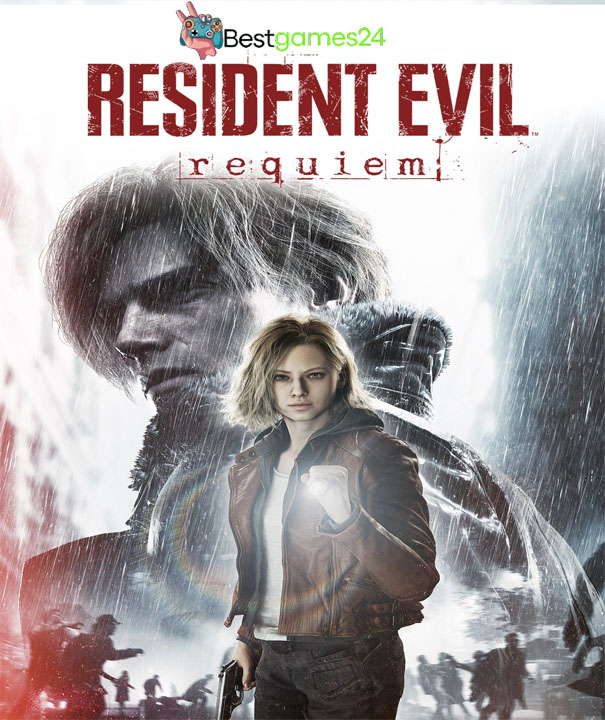
- Platform: PS5, Xbox Series X, PC (Steam),
- Nintendo Switch 2 Developer/Publisher: Capcom
- Release Date: February 27, 2026
- Genre: Survival Horror / Action
- Rating: 9.5/10 — Essential
After 30 years of zombies, bioterror, and beloved protagonists, Capcom has delivered what many fans and critics are calling the finest entry in the Resident Evil franchise since the legendary RE4. Resident Evil Requiem, the ninth mainline chapter in the iconic series, is more than just a sequel — it is a bold, emotional, and brilliantly designed love letter to everything that has made Resident Evil a cultural institution. From its dual-protagonist structure to its innovative Blood Collector mechanic, Requiem earns its place not just as one of 2026’s best games, but as one of the greatest survival horror titles ever made.
Story: Two Heroes, One Nightmare
At the heart of Resident Evil Requiem are two very different characters whose fates become tragically intertwined: Grace Ashcroft and Leon S. Kennedy.

Grace is an FBI analyst and the daughter of Alyssa Ashcroft, a character longtime fans will remember from Resident Evil Outbreak. When a disturbing series of unexplained deaths leads her investigation to the abandoned Wrenwood Hotel — the very place where she watched her mother die — Grace is dragged into a nightmare far beyond anything her bureau training could have prepared her for. She is not a soldier. She is not a superhero. She is terrified, and Capcom makes sure you feel every ounce of that terror.
Leon S. Kennedy, meanwhile, is the series’ most iconic returning veteran. Now older, more reflective, and battle-scarred, this is not the brash rookie cop from Resident Evil 2 nor the cocky agent from RE4. Leon feels genuinely worn by decades of bioterror operations. He is racing against time to find a cure for a mysterious illness, and his investigation pulls him directly into the same web of horrors that has ensnared Grace.
The story is set roughly 30 years after the destruction of Raccoon City, exploring how that catastrophe still casts a long shadow over governments, agencies, and individuals. Capcom uses the dual-narrative structure to ask a surprisingly deep question: what does it cost to know too much? Grace’s journey is about discovery, fear, and survival. Leon’s is about consequence, mission, and sacrifice. Together, their arcs create something genuinely moving — a quality not historically associated with this franchise. You will be fist-pumping one moment and unexpectedly emotional the next.
Gameplay: A Tale of Two Playstyles
The biggest creative risk Capcom took with Requiem was splitting the campaign between two protagonists with radically different gameplay philosophies. It pays off spectacularly.
Grace’s sections are pure, nerve-shredding survival horror. She cannot fight her way through problems — she must think, sneak, and adapt. Her hands visibly shake when she first fires a gun, and this is reflected mechanically: her aim is less stable, and recoil is more punishing. Players controlling Grace are constantly listening for creaking floors, muffled breathing through walls, and distant footsteps. She can crouch to reduce noise, hide under furniture, and use environmental objects like glass bottles to create distractions. The tension during her sequences is relentless and masterfully crafted. Capcom makes the player feel Grace’s fear rather than simply telling them about it.
Leon’s sections, by contrast, are an adrenaline-fueled action showcase. He kicks down doors, hurls axes with deadly precision, and mows through hordes of infected with the casual confidence of a man who has saved the world more than once. Where Grace needed hours to survive a single mansion wing, Leon can tear through the same area in minutes. This contrast — experiencing identical spaces through two completely different lenses — is one of the game’s greatest design triumphs. Enemies that once filled you with dread as Grace become manageable obstacles as Leon. It is deeply satisfying.
The seamless interweaving of these two playstyles is most brilliantly realized in the Care Center mansion, a location players visit as both characters. Solved puzzles, opened drawers, and downed enemies from Grace’s earlier run persist into Leon’s campaign. You feel the weight of your earlier struggle and the relief of now having real firepower. It is elegant, layered level design of the highest order.
The Blood Collector Mechanic: A Brilliant New System
One of Requiem’s most praised new features is the Blood Collector, an innovative crafting mechanic that adds a rewarding layer of strategy to combat. Players can use blood specimens harvested from downed enemies to fill an injector. Once enough samples are collected, they can be used to craft health items, ammunition, and even new weapons.
This system effectively introduces an RPG-like reward loop to exploration and combat. Taking out specific enemy types yields different and more valuable blood specimens, encouraging players to engage rather than avoid confrontations. It adds meaningful depth to resource management — a cornerstone of the Resident Evil experience — without ever feeling like padding or busywork. It is one of those elegant mechanics that feels obvious in hindsight but required real creative courage to execute.
Level Design and Atmosphere
Capcom’s level design in Requiem is among the best in the franchise’s history. The environments strike a careful balance between the familiar and the menacing. Raccoon City’s legacy haunts every darkened corridor and moldering hallway. The Wrenwood Hotel in particular is a stunning achievement — a space that evolves in meaning and feeling depending on which protagonist is navigating it.
The atmosphere is relentless. The game opens in near-total darkness, your nerves fraying before you even encounter your first enemy. Capcom’s lighting design is exceptional — shadows are your enemy and your only ally simultaneously. The graphics on PS5 and high-end PC are stunning, with grotesquely detailed enemy designs, realistic facial animations, and environments that feel genuinely lived-in and decayed. Even on Nintendo Switch 2, players have noted that the visuals are remarkably impressive for the platform.
Pacing and Length: Quality Over Quantity
Resident Evil Requiem is not a long game. Most players will complete it in approximately 10 hours on their first playthrough. In a gaming landscape bloated with 80-hour open worlds, this might raise eyebrows. It should not. Every minute of Requiem is purposeful. There are no redundant fetch quests, no artificially stretched stealth sequences, no filler. Every puzzle, every corridor, every explosive action beat earns its place.
This disciplined restraint is one of Requiem’s most impressive qualities. Capcom understood that tightly choreographed pacing creates more lasting impact than sheer volume. The result is a game that respects your time while delivering an experience that feels complete, satisfying, and — on a second playthrough — even richer.
A Celebration of 30 Years
Resident Evil Requiem works as a standalone experience, but it sings for longtime fans. References to RE2, RE3, Outbreak, and even the CGI films are woven throughout the narrative and environment. Returning characters and locations carry the weight of history without ever tipping into cheap nostalgia. Capcom uses these callbacks as emotional and narrative tools — reminders of where characters like Leon have been and prompts to reflect on what the franchise means to you personally.
The title itself is meaningful. A requiem — a mass for the dead — captures both the game’s elegiac tone and its role as a kind of closing statement on decades of Raccoon City history. Yet it also opens new doors. Grace Ashcroft is a compelling enough protagonist to carry the series forward, and Capcom has already confirmed extra story content is in development.
Verdict: Essential
Resident Evil Requiem is a masterclass in survival horror. It expertly blends the tension of classic RE with the bombastic energy of its action-oriented entries. Its dual-protagonist structure is executed with remarkable creative precision. Its story is surprisingly emotional and deeply character-driven. Its mechanics — from Grace’s stealth-driven survival gameplay to the Blood Collector system — feel fresh and purposeful. And it does all of this in a tightly paced, beautifully crafted 10-hour experience that never wastes a single moment.
On Steam, it holds an “Overwhelmingly Positive” rating with 96% of nearly 47,000 reviews recommending it. Critics across the board have placed it among the franchise’s absolute best. After 30 years of Resident Evil, Capcom has somehow managed to produce something that feels both deeply familiar and genuinely new.
If you play one horror game in 2026, make it Resident Evil Requiem. It is not just the best Resident Evil game in decades — it may be the best one ever made.
Score: 9.5 / 10
Reviewed on PlayStation 5. Also available on PC (Steam), Xbox Series X, and Nintendo Switch 2.
Frequently Asked Questions
Is Resident Evil Requiem worth playing? Absolutely. It is one of the highest-rated games of 2026 and widely considered the best Resident Evil game since RE4.
How long is Resident Evil Requiem? The main campaign takes approximately 10 hours to complete — but every minute is packed with purpose.
Do I need to play previous Resident Evil games first? Newcomers can enjoy Requiem as a standalone experience. However, longtime fans will appreciate the deep ties to RE2, RE3, and Outbreak.
What platforms is Resident Evil Requiem on? PS5, Xbox Series X, PC (Steam), and Nintendo Switch 2. It released on February 27, 2026.
Who are the main characters in Resident Evil Requiem? Grace Ashcroft, a new FBI analyst protagonist, and Leon S. Kennedy, the fan-favorite returning veteran from RE2 and RE4.